Skip to content
  • What We Do
    • Our Work in Prisons
    • Peer Research
    • Peer Commissioning
    • Policy Influencing
    • News & Blog
  • About Us
    • Our Story
    • Meet the Team
    • Our Values
    • Our Strategy
  • Impact
    • Impact Reports
    • Annual Reports
  • Funders
  • Vacancies
    • Vacancies
    • Volunteer
    • Internships
  • What We Do
    • Our Work in Prisons
    • Peer Research
    • Peer Commissioning
    • Policy Influencing
    • News & Blog
  • About Us
    • Our Story
    • Meet the Team
    • Our Values
    • Our Strategy
  • Impact
    • Impact Reports
    • Annual Reports
  • Funders
  • Vacancies
    • Vacancies
    • Volunteer
    • Internships
Contact Us

Peer Research

“Speaking to people about their experience of the justice system makes me feel less alone – and more powerful”
Jordan
JordanPeer Researcher
“I had social anxiety before, even around friends and family. User Voice has helped me learn how to manage those situations – and believe in myself again.”
Ahmed
AhmedPeer Researcher
"We worked with User Voice on a recent smoking cessation project and the partnership really made the work very comprehensive. It gave us a much better insight into the views of people in our prisons and, above all, demonstrated the strength of feeling around vaping within prisons, that there was a high level of concern amongst residents and a strong desire to stop vaping. This was something we had not previously been aware of to such an extent and made us realise that we needed to consider further work around vaping cessation. I particularly found the comments you included from residents really impactful."
Sarah Burwood, Health and Justice Programme Manager – Healthcare Public Health
Sarah Burwood, Health and Justice Programme Manager – Healthcare Public HealthNHS England – Midlands (West)
“At a time when prisons were closed to the outside world, we (User Voice) trained people inside to research their own prisons. That work became one of the only large-scale studies of the Covid lockdown’s impact on prisoners’ mental health -and a vital record of atraumatic time in penal history.”
Professor Shadd  Maruna
Professor Shadd Maruna

We are the specialists in amplifying the lived experience of people with convictions to drive meaningful change.

Our peer-led research consists of a range of bespoke projects that help service providers, commissioners, academics and policy makers access, hear and act upon the crucial lived experience insights of some of the most marginalised people in society. Embedding service user insights into the design and evaluation of services is key in elevating consumer research to improve services, and the justice system should be no exception.

We are proud to partner with organisations including the Cabinet Office, HM Inspectorate of Probation, the London Mayor’s office, the University of Kent, Sheffield Hallam University, Loughborough University, and the NHS to embed lived experience in their improvement strategies and service provision.

To find out more about our trailblazing peer research work see below.

Read More

Recent Publications

Loading...

The Voice of People on Probation

More Info
Modal Title test

The Voice of People on Probation

As part of User Voice’s relationship HM Inspectorate of Probation, over 2,500 people had their voice heard as part of thirty-four regional inspections of Probation Deliver Units and four thematic inspections over the past year. The relationship between the two organisations continues to grow as thousands more will have their voices heard in the years to come.

This report outlines the voice of people on probation for the inspection titled ‘Race equality in probation follow-up: A work in progress. A thematic inspection’ and is just one part of the full inspection. Therefore, we recommend reading the full report published by HM Inspectorate of Probation that we make reference to in this report to get a complete picture.

Download

The Voice of People on Probation

More Info
Modal Title test

The Voice of People on Probation

This report that outlines the voice of people on probation for the inspection titled ‘A thematic inspection of work undertaken, and progress made, by the Probation Service to reduce the incidence of domestic abuse and protect victims’ and is one part of the full inspection.

Download

Coping with COVID in Prison

More Info
Modal Title test

Coping with COVID in Prison

INNOVATIVE STUDY FINDS COVID-19 MEASURES LEADING TO SEVERE MENTAL HEALTH CRISIS IN PRISONS

1 in 3 prisoners show symptoms of “severe anxiety disorder” indicating high levels of post-traumatic stress

‘Coping with Covid in Prisons’ research has found Covid-response measures led to periods of prolonged solitary confinement across the prison population, resulting in dramatically increased levels of anxiety and depression.

The study, funded by the Economic and Social Research Council, was a partnership between the ex-offender led charity User Voice and social scientists at the Queen’s University Belfast.

One of the most comprehensive studies of life in prison during the pandemic completed internationally, the project drew on an innovative peer-led methodology, developed by User Voice. Nearly 100 serving prisoners were trained in research methods to survey their peers. Over the 18-month project, they completed over 1,400 surveys with fellow prisoners across 11 prisons, including the women’s estate, young offender institutions, and all categories of prisons.

The unique study found that prolonged isolation and the simultaneous reduction in support services, resulted in widespread deterioration of mental health and the erosion of the rehabilitative function of imprisonment.

 Key findings:

  • 85% of surveyed prisoners were confined to cells for 23 hours for the majority of the lockdown period.
  • 59% of surveyed prisoners had not had a single family visit during the Covid lockdown.
  • Standard wellbeing screening tools suggest depression and anxiety scores are almost 5 times higher than the standard for the general population.
  • More than 1 out of 3 prisoners were scoring at the level of “severe anxiety disorder” indicating high levels of post-traumatic stress.
  • Two thirds of survey respondents said that access to mental health support had worsened, instead of improving, during the lockdown.
  • 1 out of 5 respondents thought that violence had reduced in the prisons because of the lockdown.
Download

Coping with COVID in Prison

More Info
Modal Title test

Coping with COVID in Prison

INNOVATIVE STUDY FINDS COVID-19 MEASURES LEADING TO SEVERE MENTAL HEALTH CRISIS IN PRISONS

1 in 3 prisoners show symptoms of “severe anxiety disorder” indicating high levels of post-traumatic stress

‘Coping with Covid in Prisons’ research has found Covid-response measures led to periods of prolonged solitary confinement across the prison population, resulting in dramatically increased levels of anxiety and depression.

The study, funded by the Economic and Social Research Council, was a partnership between the ex-offender led charity User Voice and social scientists at the Queen’s University Belfast.

One of the most comprehensive studies of life in prison during the pandemic completed internationally, the project drew on an innovative peer-led methodology, developed by User Voice. Nearly 100 serving prisoners were trained in research methods to survey their peers. Over the 18-month project, they completed over 1,400 surveys with fellow prisoners across 11 prisons, including the women’s estate, young offender institutions, and all categories of prisons.

The unique study found that prolonged isolation and the simultaneous reduction in support services, resulted in widespread deterioration of mental health and the erosion of the rehabilitative function of imprisonment.

 Key findings:

  • 85% of surveyed prisoners were confined to cells for 23 hours for the majority of the lockdown period.
  • 59% of surveyed prisoners had not had a single family visit during the Covid lockdown.
  • Standard wellbeing screening tools suggest depression and anxiety scores are almost 5 times higher than the standard for the general population.
  • More than 1 out of 3 prisoners were scoring at the level of “severe anxiety disorder” indicating high levels of post-traumatic stress.
  • Two thirds of survey respondents said that access to mental health support had worsened, instead of improving, during the lockdown.
  • 1 out of 5 respondents thought that violence had reduced in the prisons because of the lockdown.
Play

Children’s experiences of ETE

More Info
Modal Title test

Children’s experiences of ETE

Children in the criminal justice system face many challenges that impact their progression through Education, Training and Employment (ETE). This report presents the experiences of twenty-nine children in six Youth Offending Services (YOS) across the UK. The main objectives of the research were to understand the challenges faced by children when trying to access ETE, to identify effective practice and to establish how services can achieve the best outcomes for children.

Overall, the children we spoke to had complex needs and chaotic personal lives, they were living in care, had substance misuse issues or were homeless. They also reported having learning difficulties, neurodivergent disorders and poor mental health. Anxiety was a key barrier preventing a number of the children from attending ETE, even when it was something that they genuinely wanted to do.

The children spoke of a desire to move on, they wanted to get a job or acquire a skill that they could use moving forward. However, many had a mediocre experience of ETE, with very little awareness of the ETE options, little choice in which ETE they did and no ETE plan to speak of.

The biggest issue for them, outside of their personal circumstances, was the lack of relevance or consideration for their skills, interests, abilities and circumstances. Despite a lack of relevance for many, 4 in 5 children we spoke to reported some benefit from engaging with ETE, and with the YOS more generally, particularly around soft skills. Many of the children did mention how ‘nice’ their YOS worker was and some reflected on the lengths they go to support them.

Children who had positive outcomes described not only a good relationship with their YOS worker, but also having a choice and being involved in decision making around ETE. These children had assessments and plans that they felt a part of, and their individual learning and personal needs were understood and catered to. They were developing skills in a number of areas, such as academic, behaviour and life skills, and reported feeling supported to achieve their goals.

This consultation was commissioned by Her Majesty’s Inspectorate of Probation (HMIP) as part of a wider review, read the HMIP report and watch the launch event.

Download

Experiences of BAME Boys
in Youth Services

More Info
Modal Title test

Experiences of BAME Boys
in Youth Services

In this report, we present the experiences of black and mixed heritage boys within youth offending services and partner agencies. The principal objectives of the consultation were to understand their experiences of going through the criminal justice system, and to identify any particular challenges they faced. Moreover, we aimed to assess the effectiveness and quality of the support received from Youth Offending Services.


Download

Neurodiversity in the criminal justice system

More Info
Modal Title test

Neurodiversity in the criminal justice system

Neurodiversity within the criminal justice system is an under-researched but vitally important issue. Neurodiversity covers many conditions related to how the brain functions including ADHD, autism, intellectual disabilities, traumatic brain injury and motor disorders.

Estimates suggest that neurodiverse conditions are three times more common in the criminal justice system than in the general population. However, our findings indicate that there is limited screening for these conditions and the true figure may be much higher.

User Voice, a charity run by people with lived experience of the criminal justice system, directly engaged with 118 people in prison and on probation who had a diagnosed neurodiverse condition across 10 probation services in England.

This consultation was commissioned by Her Majesty’s Inspectorate of Probation as part of a wider review on neurodiversity in the criminal justice system being carried out on behalf of the Ministry of Justice.


Download

Covid Lockdown: Experiences from Prison

More Info
Modal Title test

Covid Lockdown: Experiences from Prison

Prisons were rightly identified as a serious risk of contagion at the beginning of the COVID-19 emergency. The pandemic has seen restrictions introduced in UK prisons which wouldn’t have been out of place 100 years ago. And probation, that essential support service, was suddenly distant. What has been the effect of this on service users? How has the pandemic impacted people who are already locked down?

Download

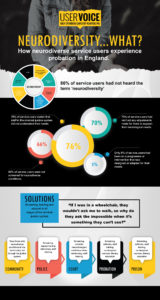
Neuro… What?
(Infographic)

More Info
Modal Title test

Neuro… What?
(Infographic)

Download

Reduce re-offending with West Yorkshire PCC

More Info
Modal Title test

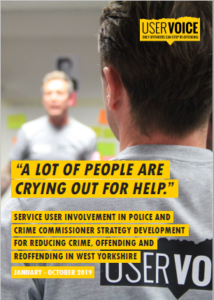
Reduce re-offending with West Yorkshire PCC

To reduce re-offending, West Yorkshire Police Crime Commissioner, Mark Burns-Williamson, asked the people who commit crime. Utilizing and valuing their experience, West Yorkshire PCC commissioned User Voice to ask service users what it takes to reduce crime in West Yorkshire.

We asked over 300 people in prison and on probation what they thought. Homelessness, mental health, education and addiction: these cause people to offend.

Armed with this information, West Yorkshire PCC have developed a reducing re-offending strategy that targets the causes of crime.

Download
1 2 3 Next »

Past Publications

Loading...

2025 User Voice. All Rights Reserved. Privacy Notice.

Registered Charity No. 1136047
Company Limited by Guarantee no. 06820227

Twitter Facebook Instagram Phone
Work With Us
Contact Us
Twitter Facebook Instagram Phone Linkedin

020 3137 7471

info@uservoice.org

20 Newburn St, London, SE11 5PJ


Manage Consent
To provide the best experiences, we use technologies like cookies to store and/or access device information. Consenting to these technologies will allow us to process data such as browsing behaviour or unique IDs on this site. Not consenting or withdrawing consent, may adversely affect certain features and functions.
Functional Always active
The technical storage or access is strictly necessary for the legitimate purpose of enabling the use of a specific service explicitly requested by the subscriber or user, or for the sole purpose of carrying out the transmission of a communication over an electronic communications network.
Preferences
The technical storage or access is necessary for the legitimate purpose of storing preferences that are not requested by the subscriber or user.
Statistics
The technical storage or access that is used exclusively for statistical purposes. The technical storage or access that is used exclusively for anonymous statistical purposes. Without a subpoena, voluntary compliance on the part of your Internet Service Provider, or additional records from a third party, information stored or retrieved for this purpose alone cannot usually be used to identify you.
Marketing
The technical storage or access is required to create user profiles to send advertising, or to track the user on a website or across several websites for similar marketing purposes.
Manage options Manage services Manage {vendor_count} vendors Read more about these purposes
View preferences
{title} {title} {title}

Contact Us